Review Manual for the Certified Healthcare Simulation Educator™ (CHSE™) Exam, 2nd Edition
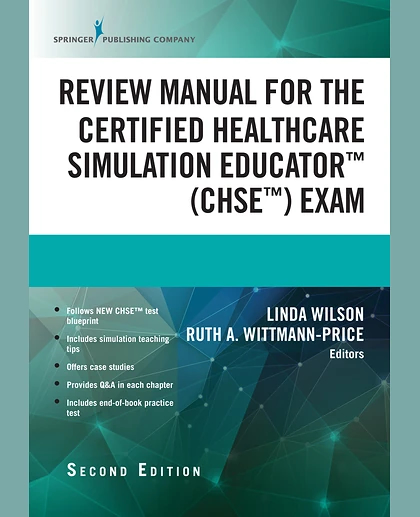
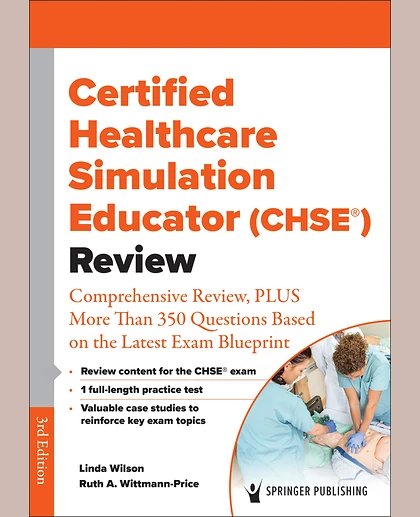
Review Manual for the Certified Healthcare Simulation Educator™ (CHSE™) Exam, 2nd Edition
Summary
Simulation is one of the teaching modalities needed to improve patient safety because it teaches healthcare providers interprofessional collaboration, communication, and cooperation like never before in the history of healthcare. The authors are simulation and education experts who have added features that will assist in critically analyzing the content. Evidence-Based Simulation Practice boxes assist us in focusing on the current simulation research. Case Studies and Practice Questions at the end of each chapter promote critical thinking and situational decision making. Section I covers the specifics of the examination, the activities needed to reach advanced certification, and recertification. It concentrates on the current 2014 certification test plan and provides us with test-taking strategies”. Section II discusses professional values and capabilities in relation to teaching with simulation. Section III reviews foundational knowledge about simulation and includes a chapter on the theoretical background of learning using simulation. Integrating simulation education into a professional healthcare curriculum is discussed, and the legal and ethical issues that are sometimes encountered with simulation experiences are explored. Other foundational issues include principles, practice, and methodologies related to the human patient simulator, along with the art of moulage. The section also discusses standardized patient simulation and talks about using hybrid simulation. It then addresses interprofessional simulation experiences, and discusses the very important postsimulation experiences of debriefing and providing learners with feedback. It provides important information about the ever-increasing use of virtual reality as a teaching/learning tool. Section IV focuses on the practicalities of simulation laboratories. It discusses planning, implementing, and evaluating the learners using simulation activities. Section V reviews simulation laboratory resource management and the environment considerations. It also reviews accreditation and standards of simulation laboratories. Section VI addresses academic considerations of simulation educators, including professional development and career advancement and the role and current status of simulation research.