Computational Intelligence in Industry 4.0 and 5.0 Applications: Trends, Challenges and Applications
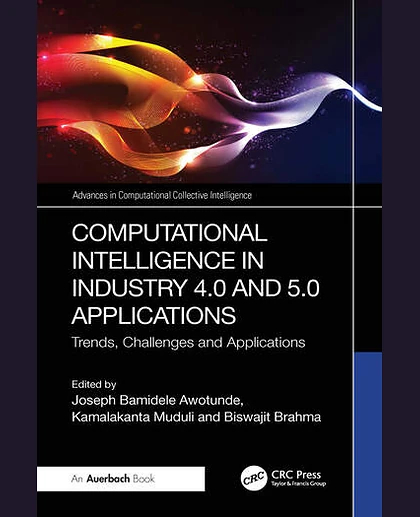
Computational Intelligence in Industry 4.0 and 5.0 Applications: Trends, Challenges and Applications
Summary
Industry 4.0 and 5.0 applications will revolutionize production, enabling smart manufacturing machines to interact with their environments. These machines will become self-aware, self-learning, and capable of real-time data interpretation for self-diagnosis and prevention of production issues. They will also self-calibrate and prioritize tasks to enhance production quality and efficiency.
Computational Intelligence in Industry 4.0 and 5.0 Applications examines applications that merge three key disciplines: computational intelligence (CI), Industry 4.0, and Industry 5.0. It presents solutions using Industrial Internet of Things (IIoT) technologies, augmented by CI-based techniques, modeling, controls, estimations, applications, systems, and future scopes. These applications use data from smart sensors, processed through enhanced CI methods, to make smart automation more effective.
Industry 4.0 integrates data and intelligent automation into manufacturing, using technologies like CI, the IoT, the IIoT, and cloud computing. It transforms data into actionable insights for decision-making and process optimization, essential for modern competitive businesses managing high-speed data integration in production processes. Currently, Industries 4.0 and 5.0 are undergoing significant transformations due to advances in applying artificial intelligence (AI), big data analytics, telecommunication technologies, and control theory. These applications are increasingly multidisciplinary, integrating mechanical, control, and information technologies. However, they face such technical challenges as parametric uncertainties, external disturbances, sensor noise, and mechanical failures. To address these, this book examines such CI technologies as fuzzy logic, neural networks, and reinforcement learning and their application to modeling, control, and estimation. It also covers recent advancements in IIoT sensors, microcontrollers, and big data analytics that further enhance CI-based solutions in Industry 4.0 and 5.0 systems.