Climate Urbanism and Vulnerability: Public Perceptions, Urban Risk, and Mapping Inequities in a Changing Climate
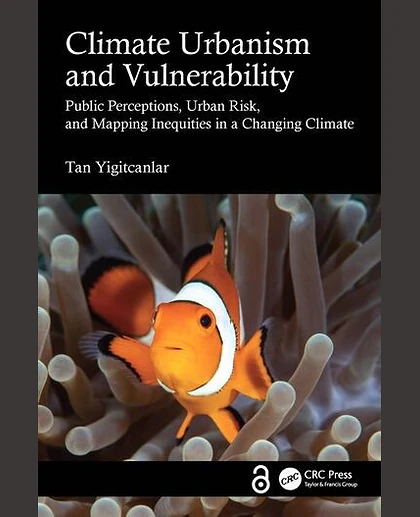
Climate Urbanism and Vulnerability: Public Perceptions, Urban Risk, and Mapping Inequities in a Changing Climate
Summary
This book delves into the intricate relationship between climate change, urbanisation, political attitudes, and spatial inequities, examining how these elements collectively shape vulnerability in cities. This comprehensive book, structured across ten chapters and three core themes (public perception, urban exposure, and methodological innovation) presents an integrated framework that unifies social science, spatial analysis, and data science. Unlike narrower approaches, it bridges the gap between technical metrics and social responses to urban climate challenges.
The book explores how political worldviews influence climate risk perception and how peri-urbanisation intensifies vulnerability, particularly focusing on the disproportionate impact of heat in rapidly expanding cities. It reveals that while public awareness of climate change is present, a significant gap exists between awareness and individual action, with calls for more effective government responses and integrated climate strategies. It also highlights how advanced technologies like AI, machine learning, and remote sensing are transforming the assessment and visualisation of urban climate risks. Specifically, it demonstrates how remote sensing quantifies the intensification of climate change due to urban greenfield expansion, revealing ecosystem loss and increased emissions, especially in peri-urban areas. This underscores the need for policies prioritising ecosystem protection for climate mitigation. Furthermore, the book provides a bibliometric review of urban heat vulnerability research, showcasing its rapid growth and evolution across diverse fields such as urban planning, environmental dynamics, public health, climatology, and remote sensing. It notes a crucial shift towards human-centred approaches and advocates for integrated policies to effectively manage escalating urban heat risks.
This book is an indispensable resource for practitioners in the field, including city government officials, policymakers, urban planners, and consultants. It can also be used as a reference for researchers and university students in urban studies.