
Alternative Revenue Models for Advanced Batteries
Alternative Revenue Models for Advanced Batteries
Summary
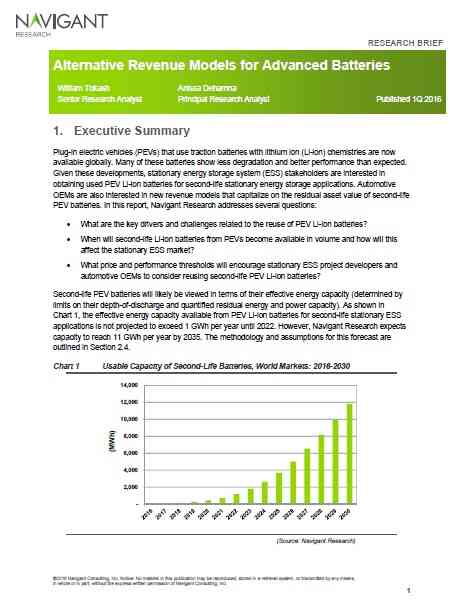
The release of the Chevrolet Volt and Nissan LEAF in 2010 ushered in the modern era of mainstream vehicle electrification. Plug-in electric vehicles (PEVs) that use traction batteries with lithium ion (Li-ion) chemistries are now available globally. Many of these batteries show less degradation and better performance than expected and may have value after their vehicle life is over. As such, stationary energy storage system (ESS) stakeholders have expressed interest in obtaining used PEV Li-ion batteries for second-life stationary energy storage applications. Automotive OEMs may also be interested in new revenue models that capitalize on the residual asset value of second-life PEV batteries.
Given these evolutions, the question today is: What will happen to all of the used but still capable batteries? The answer may lie in reusing them for stationary ESS applications. Reusing recovered batteries for stationary applications solves a significant problem: new batteries may still cost too much to allow for their profitable use on the grid in most areas. Used but capable batteries, however, can likely be sold at a low price and still provide a useful function.
This Navigant Research report explores the concept of reusing PEV Li-ion batteries for stationary ESS applications. The study examines the issues, including market drivers and challenges, related to second-life batteries and suggests moves for stakeholders to help make the concept become a reality. Global forecasts for the availability and capacity of these batteries, as well as their future price ceilings, are provided. The report also assesses the residual energy storage asset value and alternative revenue streams associated with the reuse of PEV Li-ion batteries.