
Fuel Cell Vehicles
Fuel Cell Vehicles
Summary
Fuel cell vehicles (FCVs) are once again in the public eye, thanks to Toyota?s rollout of its first production-level fuel cell car, the Mirai, in 2015. The Mirai joins Hyundai?s fuel cell-powered Tucson as the only commercially available fuel cell cars today as this market continues to focus on two key requirements for larger-scale commercial introduction. The first is driving down the vehicle cost so fuel cell cars and buses can approach the cost of battery and hybrid technology, and the second is developing the hydrogen infrastructure needed to fuel these vehicles.
Today, OEMs are part of the infrastructure equation, as they have been for battery electric vehicles (BEVs). This involvement requires collaboration with new partners in retail fueling and hydrogen supply. Fuel cell buses face a less daunting infrastructure challenge since buses can utilize a central fueling facility. This application is also focused on cost reduction, however. For both the fuel cell car and fuel cell bus markets, governments continue to be a key factor as they spur the deployment of lower emissions technologies and fund the buildout of hydrogen stations. Meanwhile, FCVs must also compete with BEVs, which have been available as commercial products since 2010, and zero emissions vehicles (ZEVs).
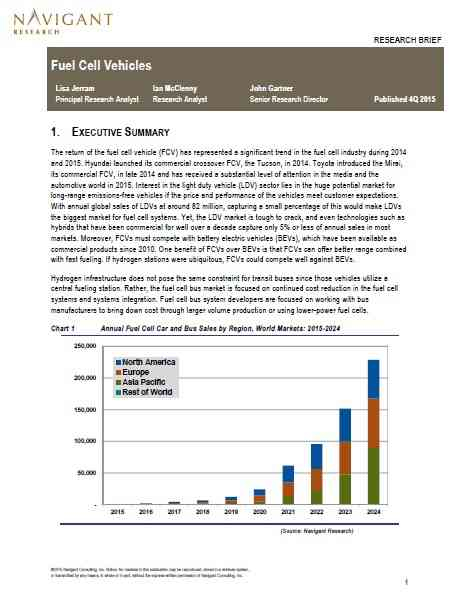
This Navigant Research brief assesses the state of global fuel cell passenger car and bus development and progress made in addressing the main barriers to successful commercialization. The study discusses the top government initiatives to support this goal and the key infrastructure and cost issues related to FCVs. Global sales forecasts of FCVs, segmented by region (North America, Europe, Asia Pacific, and Rest of World), extend through 2024. The report also examines the prospects for fuel cell cars and buses to reach widespread commercial deployment and compete against other technologies and profiles a few of the key players in the FCV market.