
Residential Customer Engagement
Residential Customer Engagement
Summary
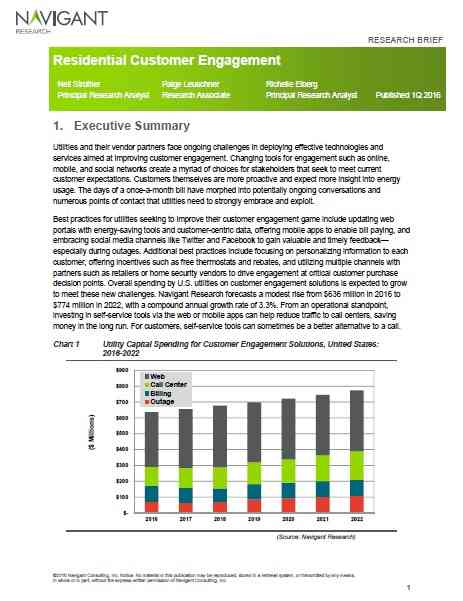
Utilities and their vendor partners face ongoing challenges in deploying effective technologies and services for improving customer engagement. Changing tools for engagement such as online, mobile, and social networks create a myriad of choices for stakeholders that seek to meet current customer expectations. Customers are more proactive and expect more insight into energy usage. The days of a once-a-month bill have morphed into potentially ongoing conversations and numerous points of contact that utilities need to strongly embrace and exploit.
For their part, utilities want to use energy efficiency (EE) programs and demand-side management (DSM) measures to reduce load and avoid constructing new, expensive supply, which requires customer participation. Today, utilities need to engage customers in new ways through multiple channels?and for multiple purposes. Best practices for utilities seeking to improve their customer engagement game include updating web portals with energy-saving tools and customer-centric data, offering mobile apps to enable bill paying, and embracing social media channels like Twitter and Facebook to gain valuable and timely feedback?especially during outages. Given these new engagement pressures, overall spending by U.S. utilities on customer engagement solutions is expected to increase in coming years in an effort to meet these new expectations.
This Navigant Research report examines the key market drivers and inhibitors related to utility residential customer engagement. The report highlights several case studies where utilities are providing the additional tools and communications pathways customers expect today. Some of the major players that aim to support enhanced customer relationships in the utility customer engagement space are profiled, including telecommunications providers, broadband companies, home security providers, tech companies, distributed energy resources (DER) vendors, and others that solely serve utilities. The study also provides a set of best practices for utilities and their partners as they navigate this changing customer engagement landscape.