
Global Energy Efficiency Policy Analysis
Global Energy Efficiency Policy Analysis
Summary
Commercial buildings have become an area of focus for global governments and regulatory agencies since they are large consumers of the world?s energy. During the past 5 years, energy efficiency policies have increased, influenced largely by requirements from the European Union (EU). Policies for buildings vary by region and country, with more developed nations taking a more stringent approach to energy efficiency. The largest barrier to energy efficiency policy for commercial buildings around the world is the lack of enforcement. Increased regulation of policies, codes, and benchmarking must be enforced for successful policy reform.
The EU?s energy efficiency regulations require its member states to create and enforce their own internal policies. These requirements have forced member states to proactively address energy efficiency in buildings and create their own policies surrounding these issues. Other regions have followed Europe?s lead and enforced their own policies and emissions targets. Additionally, the Paris Climate Summit has helped drive policy creation and reform related to energy efficiency worldwide. Beyond government administrations, a number of additional organizations are pushing for increased energy efficiency in buildings. These organizations have worked to create labeling and benchmark requirements and have set a precedent for building energy efficiency.
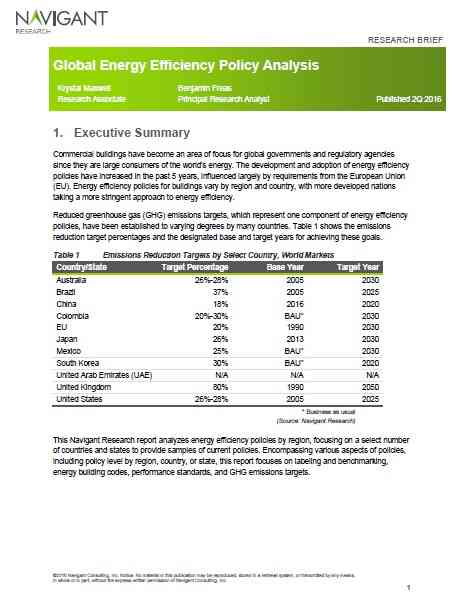
This Navigant Research report analyzes global energy efficiency policies by region. Samples of current policies are provided and assessed for a select number of states and countries. The study encompasses various aspects of policies, including policy level, with a focus on labeling and benchmarking, energy building codes, performance standards, and greenhouse gas (GHG) emissions targets. This report also provides state and country classifications based on those focus areas for certain states and countries.