
Emerging Microgrid Business Models
Emerging Microgrid Business Models
Summary
The majority of the microgrids operating today started as pilot projects or RAndD experiments. However, the industry is now moving into the next phase of project development. It appears that the main technology components of microgrids are reaching maturity, with energy storage technologies making the most dramatic leaps within the past 2 years. The key to future growth rests with greater flexibility in regulation and public policy that, in turn, are spawning business model innovation from market players both large and small.
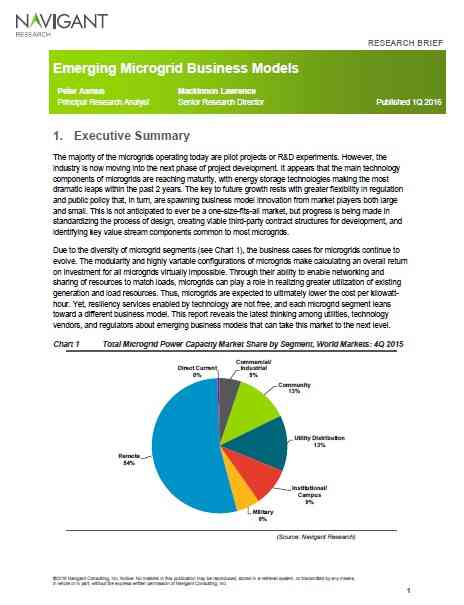
Due to the diversity of microgrid segments, the business cases for microgrids continue to evolve. The modularity and highly variable configurations of microgrids make calculating an overall return on investment for all microgrids virtually impossible. Through their ability to enable networking and sharing of resources to match loads,Microgrids can play a role in realizing greater utilization of existing generation and load resources. Yet, resiliency services enabled by technology are not free, and each microgrid segment leans toward a different business model.
This Navigant Research report examines the latest thinking among utilities, technology vendors, and regulators about emerging business models that can take the global microgrid market to the next level. The study explores 10 different business models being applied to this market today. It also provides an analysis of how different microgrid market segments gravitate toward different development strategies that reflect preferred resource mixes, existing contracting vehicles, and lessons learned from adjacent markets such as solar PV and energy storage. Tables included in the report highlight which of these models are being applied to different microgrid markets, as well as the relative maturity and financial opportunity attached to each development pathway.