
Supergrids
Supergrids
Summary
With total demand for electricity growing on a global basis and concerns over climate change mounting, significant attention is focused on how best to meet electricity needs while reducing the environmental and economic costs of power production and delivery. Much of the conversation centers on decentralized solutions, but a powerful case also exists for transforming the electric power sector in the opposite direction: through a carefully planned network of high-voltage transmission systems spanning countries, continents, and eventually the globe and enabling the integration of renewable power on a bulk scale.
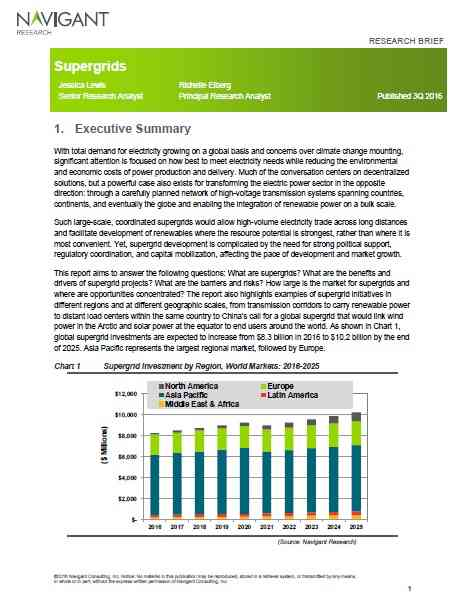
Such large-scale, coordinated supergrids would allow high-volume electricity trade across long distances and facilitate development of renewables where the resource potential is strongest, rather than where it is most convenient. Yet, supergrid development is complicated by the need for strong political support, regulatory coordination, and capital mobilization, affecting the pace of development and market growth. According to Navigant Research, global supergrid investments are expected to increase from $8.3 billion in 2016 to $10.2 billion by the end of 2025.
This Navigant Research report analyzes the market for supergrids, assessing key drivers and barriers to supergrid development and forecasting the size of the supergrid market through 2025. The study evaluates the trajectory of supergrid development by region and highlights examples of supergrid proposals at different geographic scales. Examples of supergrid initiatives covered in this report range from transmission corridors to carry renewable power to distant load centers within the same country to calls for a global supergrid linking wind power in the Arctic and solar power at the equator to end users around the world.